

The AI Subsidy Era
What will you build?

The Elevator: Curated inputs to elevate your awareness for business and life.
The most important question in tech right now: can these AI businesses generate enough revenue to match their investment obligations? And on what timeline?
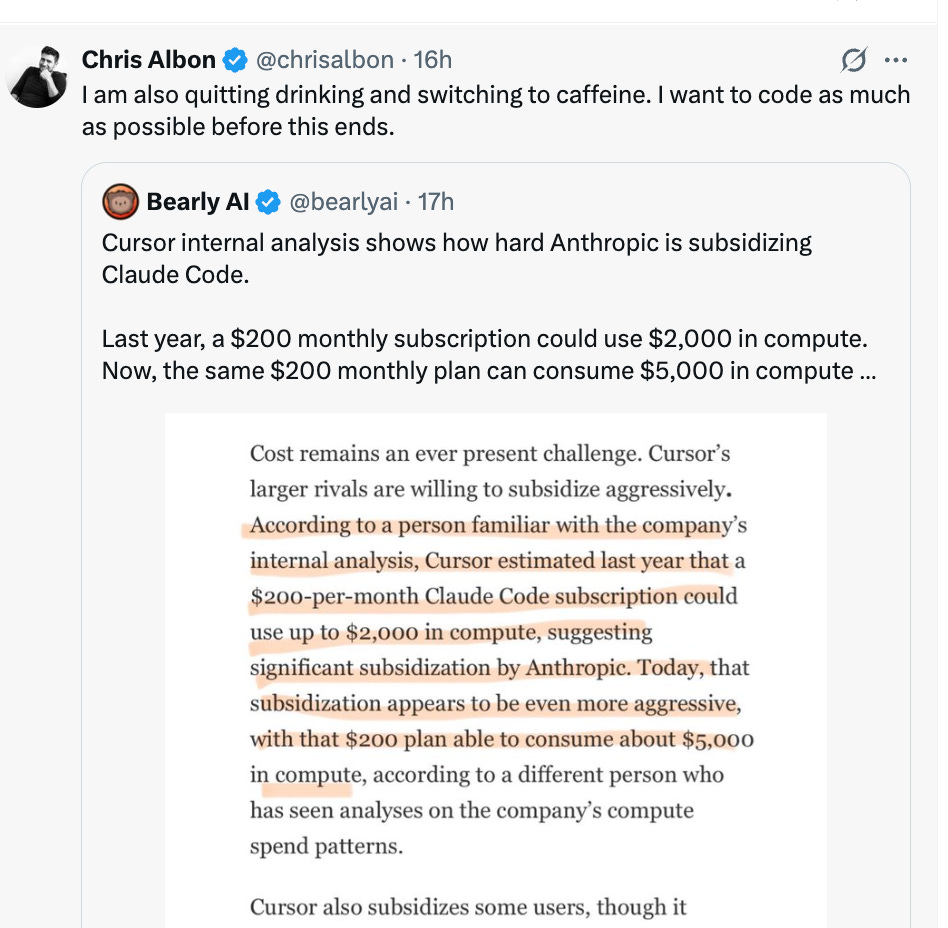
Remember $15 Ubers?
Remember when you could take an Uber across town for $15? That wasn’t real market pricing. That was venture capital subsidizing your habit. Once the network matured built, prices went up.
AI is in the early Uber/Airbnb moment right now. The products are extraordinary.
These are the fastest-growing, stickiest products of all time.
They’ve hit product-market fit on every dimension:
You want to tell everyone you know about it.
You pay for it.
You use it more and more every day.
Agents Give Users More, Model Companies Less
When you’re an average ChatGPT or Claude user, you barely use any tokens.
Tokens are cheap when you are asking about where to get dinner tonight.
As soon as you use agents, you 100x, 1,000x, 10,000x your token usage. That’s bad for margins. And yet you have to race forward because things are moving so fast you need to continue to try and position yourself to capture market share. Which means they need more funding.
OpenAI and Anthropic are racing to go public to extend the runway.
Amazon funded OpenAI’s latest round on heavily preferred terms and structured in tranches. You can tell big tech is already starting to position themselves differently for an advantage.
The External Problem: The Throttle Nobody in Tech Talks About
The speed of AI scaling didn’t happen in a vacuum. Government policy enabled it’s growth through tax incentives, energy subsidies, data center zoning etc.
The infrastructure was publicly subsidized so the private sector could scale. What if scaling too fast creates a reaction from the public that forces it’s slowdown?
What people in the tech community don’t factor into their timelines is that the faster we accelerate, the more political pushback shows up in response.
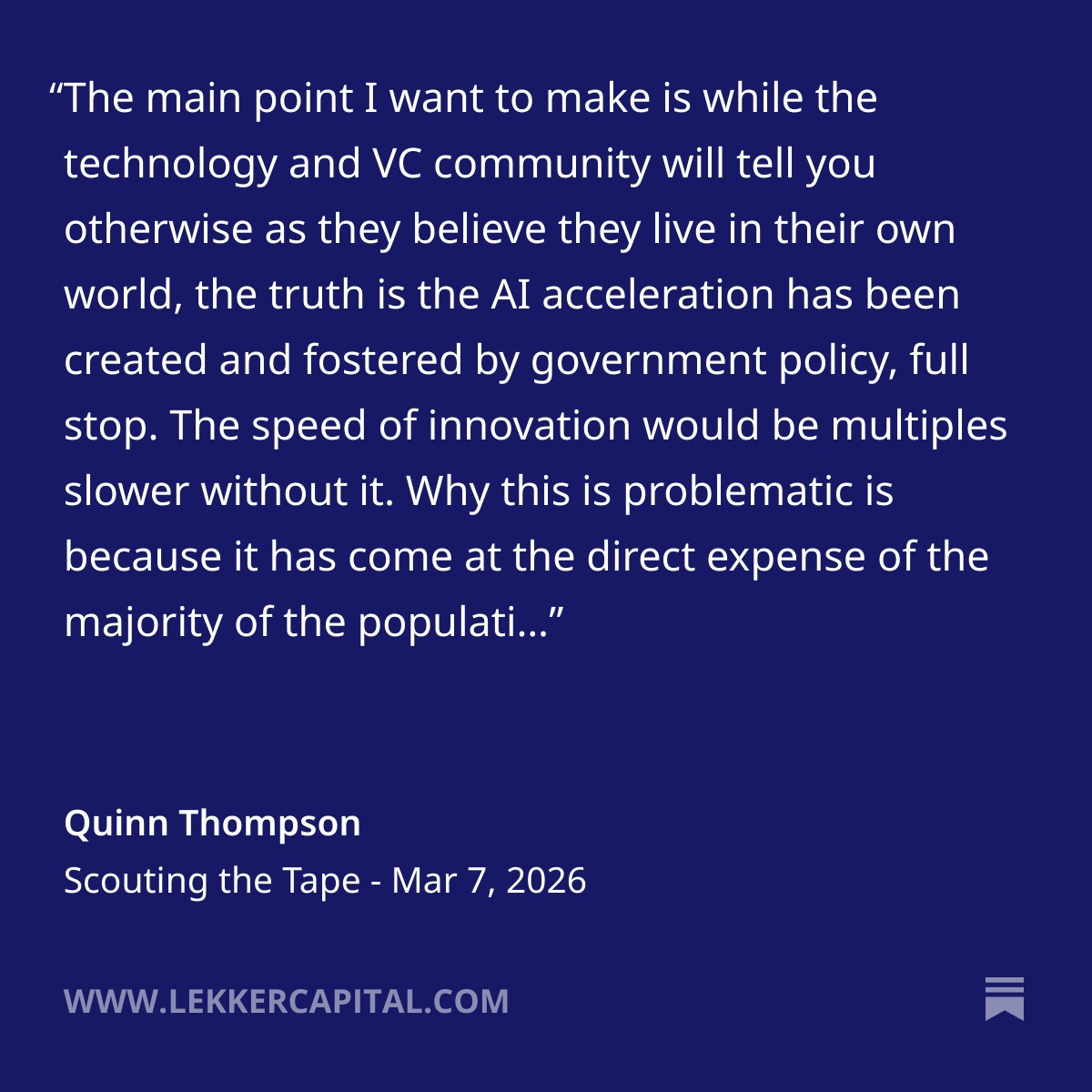
The tech pushback won’t be red vs. blue.
Red states have higher electricity costs coming to their towns, and blue states have job displacement.
Demographic shift makes it worse. By 2028, Gen Z and millennials will be a larger portion of the electorate.
This generation coming of age during the AI boom is being economically squeezed by it. You can’t afford a home and you can’t get your first job out of college.
Schrödinger's Ai
We’re holding two truths at once.
The technology is extraordinary.
The economics are unproven. The products are loved and usage is growing.
The infrastructure costs are unsustainable at current pricing.
You can be very bullish the tech and not bullish the valuations.
You can see a short term “air pocket” coming soon to the market, a gap down. And then see a setup for massive growth.
I found this Youtube video to be good pushback in terms of finding value in SAAS names that have sold off.
AI helps SaaS, doesn’t kill it: “Software companies have never been about R&D. A huge amount of these businesses are about sales and marketing, distribution, customer support. AI will help a lot of those things.”
The selloff is a pricing problem, not a business problem: “Street numbers were too high for this year, just in general. They didn’t show enough decel. So they’re going to take numbers down, give it a quarter or two, companies will start to beat numbers, then they’ll raise the numbers and the stocks will start to work.”
Earnings are the floor: “If you have earnings and free cash flow, there’s a floor. If you don’t have earnings, there is no floor.
Integration cycles are long: The mainframe business is still a $5.5 billion market. Mainframes, they came out in 1950. Oracle is a legacy software company. Microsoft is a legacy software company. SAP is a legacy software company. These companies are not going away.”
Have a great week,
xx David